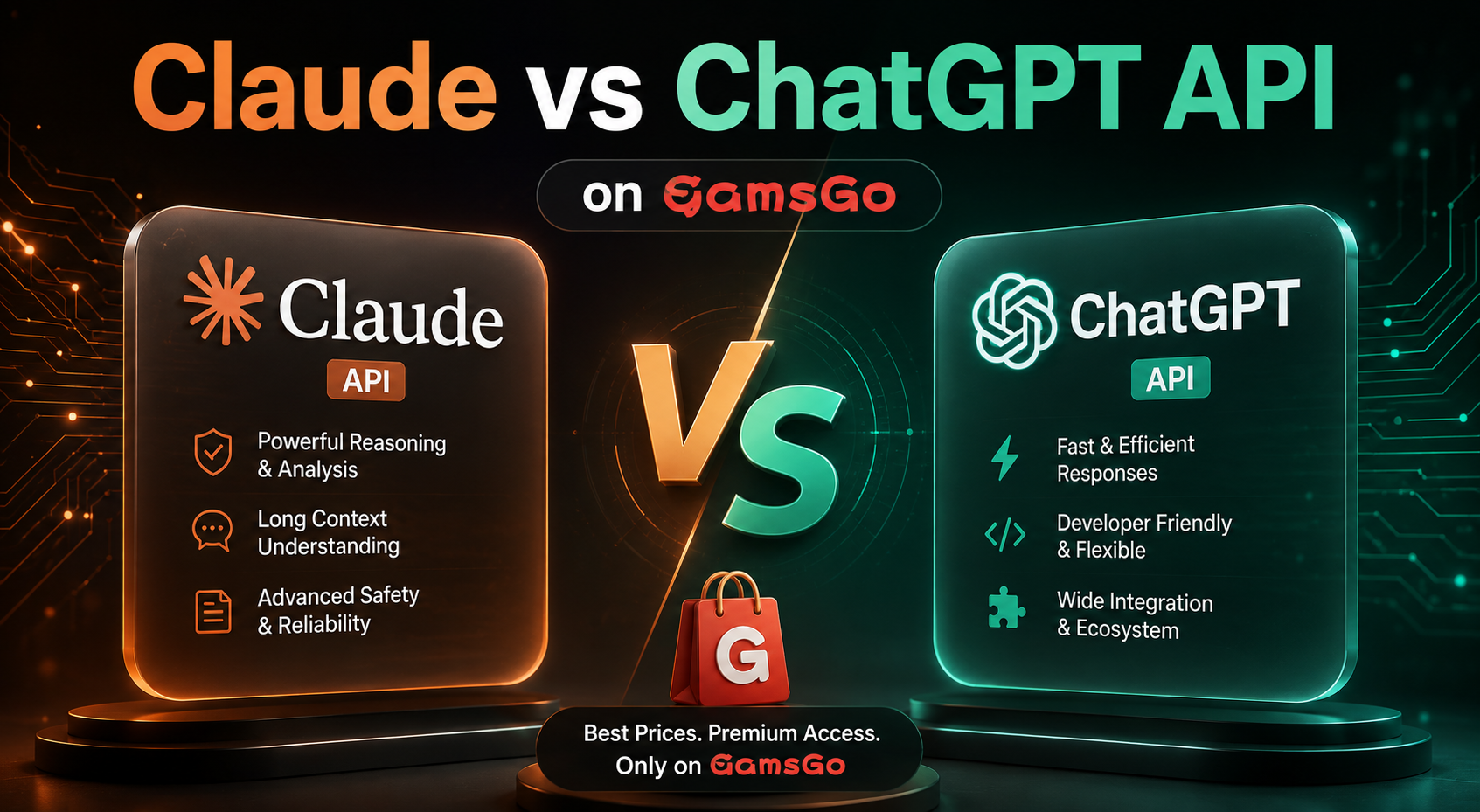
Claude vs ChatGPT API Pricing 2026: Which AI API Costs Less
A side-by-side breakdown of Anthropic's Claude API and OpenAI's ChatGPT API pricing in 2026, with real cost examples and ways to save on your monthly AI bill.
Claude vs ChatGPT API Pricing 2026: Which AI API Costs Less?
Choosing between Claude and ChatGPT on Gamsgo for your app, chatbot, or automation usually comes down to one question: which one will actually cost you less at the end of the month? Both Anthropic and OpenAI price their APIs per million tokens, but the rates, discounts, and hidden extras differ enough to swing your bill by hundreds of dollars a month once you scale up.
In this guide, we break down the real 2026 pricing for both APIs, run the numbers on identical workloads, and show you where the genuine savings are hiding including how a few smart habits (and the odd coupon) can shrink your AI spend without touching your output quality.
Claude API Pricing in 2026
Anthropic Claude API prices per million tokens (MTok), split between input and output, with extra charges for caching and certain tools. Rates currently range from $1 to $10 per million input tokens and $5 to $50 per million output tokens, depending on the model.
|
Claude Model |
Input |
Output |
Best For |
|
Claude Haiku 4.5 |
$1 / MTok |
$5 / MTok |
High-volume, simple tasks |
|
Claude Sonnet 5 |
$2 / MTok |
$10 / MTok |
Everyday apps and chatbots |
|
Claude Opus 5 |
$5 / MTok |
$25 / MTok |
Complex reasoning and coding |
|
Claude Fable 5 / Mythos 5 |
$10 / MTok |
$50 / MTok |
Frontier, high-capability workloads |
Anthropic also charges less for reused content: a cache hit costs roughly a tenth of the base input rate, which matters a lot if your app resends the same system prompt or document on every call.
ChatGPT API Pricing in 2026
OpenAI's current flagship lineup is the GPT-5.6 family, sitting alongside the still-active GPT-5.5 tier. ChatGPT API Pricing also runs per million tokens, with a noticeably wider spread between the cheapest and priciest models.
|
ChatGPT Model |
Input |
Output |
Best For |
|
GPT-5.6 Luna |
$0.20 / MTok |
$1.20 / MTok |
Bulk, low-complexity tasks |
|
GPT-5.6 Terra |
$2 / MTok |
$12 / MTok |
Balanced everyday use |
|
GPT-5.6 Sol |
$5 / MTok |
$30 / MTok |
Flagship reasoning and coding |
|
GPT-5.5 |
$5 / MTok |
$30 / MTok |
Legacy flagship, same rate as Sol |
OpenAI also runs a Batch API for a flat 50% discount and prices cached input at about a tenth of the standard rate on its current model families, very similar mechanics to Anthropic's caching system.
Claude vs ChatGPT: Side-by-Side Cost Comparison
Here's how the two providers stack up at each price tier, from cheapest to flagship.
|
Tier |
Claude |
ChatGPT |
Cheaper Option |
|
Budget model |
Haiku 4.5: $1 / $5 |
Luna: $0.20 / $1.20 |
ChatGPT (Luna) |
|
Mid-range model |
Sonnet 5: $2 / $10 |
Terra: $2 / $12 |
Claude (on output) |
|
Flagship model |
Opus 5: $5 / $25 |
Sol: $5 / $30 |
Claude (on output) |
|
Top-tier / frontier |
Fable 5: $10 / $50 |
GPT-5.5: $5 / $30 |
ChatGPT |
The pattern that stands out: on output tokens specifically, Claude tends to be a little cheaper at the mid and flagship tiers, while OpenAI wins decisively at the budget end with Luna. If your workload leans on short replies and bulk classification, ChatGPT's cheapest AI APS on GamsGo tier is hard to beat. If your app leans on longer, more detailed responses at the mid or flagship tier, Claude often edges ahead.
Real Cost Example: Same Workload, Both APIs
Let's run 10,000 input tokens and 2,000 output tokens through comparable mid-tier models from each provider.
|
Model |
Input Cost |
Output Cost |
Total per Request |
Cost per 1,000 Requests |
|
Claude Sonnet 5 |
$0.02 |
$0.02 |
$0.04 |
$40 |
|
GPT-5.6 Terra |
$0.02 |
$0.024 |
$0.044 |
$44 |
At a small scale the gap looks tiny, but multiplying that by hundreds of thousands of monthly requests and even a 10% difference adds up to a meaningful line item in your budget.
Flagship Tier Comparison
|
Model |
Input Cost |
Output Cost |
Total per Request |
Cost per 1,000 Requests |
|
Claude Opus 5 |
$0.05 |
$0.05 |
$0.10 |
$100 |
|
GPT-5.6 Sol |
$0.05 |
$0.06 |
$0.11 |
$110 |
Claude's flagship model is marginally cheaper per request here, mostly because of the lower output rate. Small margins, but they compound fast at production scale.
What Actually Drives Your AI API Bill
The sticker price per million tokens is only part of the story. These factors decide what you actually pay:
Input vs output ratio: Output tokens cost far more than input on both platforms, so chatty, long-form responses inflate your bill faster than long prompts do.
Caching: Both providers discount repeated content heavily; skipping caching on a high-traffic app is one of the easiest ways to overpay.
Batch processing: Both APIs offer roughly 50% off for non-urgent, asynchronous jobs like classification or bulk extraction.
Model routing: Sending every request to the flagship model when a budget model would do is the single biggest source of wasted AI spend.
Tool use and extras: Web search, code execution, and managed agent sessions add fees on top of token costs on both platforms.
How to Pay Less for Claude or ChatGPT API Access
Whichever API you pick, these habits shrink your monthly bill without hurting output quality:
1. Route by difficulty: Send simple tasks (classification, short replies, formatting) to the cheapest model tier, and reserve the flagship model for genuinely complex requests.
2. Turn on caching: If your prompt reuses the same system instructions, documents, or tool definitions, caching can cut that portion of your bill by up to 90%.
3. Batch what can wait: Jobs that don't need an instant response bulk tagging, reports, evaluations are the easiest 50% discount you'll ever apply.
4. Trim your output: Ask for concise responses where verbose ones aren't needed; output tokens are the most expensive part of every request on both APIs.
5. Track usage weekly, not monthly: Catching a runaway prompt or bug early saves far more than any single pricing tweak.
6. Hunt for credits and deals before you buy: Startup programs, trial credits, and marketplace discounts on API balances can meaningfully cut your upfront cost. This is exactly the kind of saving our community tracks daily.
Claude vs ChatGPT API: Which Should You Choose?
There's no single winner, it depends on your workload.
Choose Claude if: your app relies on longer, detailed outputs, complex reasoning, or coding tasks, and you want a slightly cheaper output rate at the mid and flagship tiers.
Choose ChatGPT if: your workload is high-volume and simple, since GPT-5.6 Luna's rock-bottom pricing is difficult for any competitor to match.
Choose either, but batch and cache aggressively if: you're running large-scale, non-urgent jobs both providers reward the same optimization habits equally.
Many teams end up using both: a budget model like Luna or Haiku for routine work, and Claude's Sonnet or Opus tier for anything that needs stronger reasoning.
Don't Overpay for AI Tools Let Couponcarnival Help
AI API costs are a recurring expense, and recurring expenses are exactly where a little research pays off. Before you top up your Claude Console balance or OpenAI billing, it's worth checking whether there's a promo code, cashback offer, or discounted credit bundle available the same way you'd check for a coupon before any other online purchase.
At Couponcarnival, we track the latest deals, discount codes, and cashback opportunities across AI tools, software subscriptions, and everyday online shopping, so you never pay full price when a better deal is sitting right there.
Visit Couponcarnival for the newest coupons and deals on AI tools and more. Join our WhatsApp Channel for instant deal alerts. Follow our Telegram Channel for exclusive offers you won't find anywhere else.
Frequently Asked Questions
1. Is Claude API cheaper than ChatGPT API in 2026?
It depends on the tier. ChatGPT's cheapest model (GPT-5.6 Luna) beats Claude's cheapest model (Haiku 4.5) on price, but Claude's mid and flagship models often come out slightly cheaper on output tokens than their closest OpenAI equivalents.
2. Which AI API is best for a low budget?
GPT-5.6 Luna currently offers the lowest per-token rate of any current flagship-family model from either provider, making it a strong pick for high-volume, low-complexity workloads on a tight budget.
3. Do Claude and ChatGPT both offer batch discounts?
Yes. Both Anthropic and OpenAI offer roughly 50% off standard pricing for batch, asynchronous requests that don't need an instant response.
4. Does prompt caching really save money on these APIs?
Yes. Both platforms discount cached, reused content by up to 90% compared to processing the same input fresh on every request, which adds up quickly for apps with repeated system prompts or documents.
5. Can I get a discount on Claude or ChatGPT API credits?
Direct API credits are usually pay-as-you-go, but trial credits, startup programs, and third-party discounted packages can lower your cost. Checking a deals platform like Couponcarnival before you buy is a simple way to make sure you're not leaving savings on the table.
Search Blog
blog Category






post a commment